The colour therapy It is a non-scientific alternative medicine e unverified which makes use of colours, claiming they have a therapeutic effect in the treatment of illnesses.
The use of colours would be governed by common principles, which are also applied when choosing colours in other situations, such as selecting clothes to wear or, for example, choosing suitable colours for the walls of one’s home that reflect a certain personality or stimulate (contrast with) a particular state of mind.
In summary, it can be said that chromotherapy can help the body and mind to regain their balance, bringing about both physical and mental benefits that can stimulate the body and alleviate certain symptoms.
The origins
Egypt
The Egyptians, a rather enlightened people, have provided evidence of colour therapy practices dating back to the very beginnings of their civilisation. Egyptian mythology attributes the discovery of colour therapy to the god Thoth.
According to Hermetic tradition, the Egyptians and Greeks made use of minerals, stones, crystals and coloured ointments, as well as painting the walls of their healing centres.
Again in ancient Egypt, each colour was given a name that identified its “potential”, that is to say, its function:
- the black (KeM): symbol of fertility;
- the yellow (KeNiT): a synonym for “gold” – as in alchemy – symbolises the sun god (with a continuous irradiation function);
- the red (DeSHeR): symbol of blood and fire. It could be a’positive or negative energy, but it’s always synonymous with extremism, ranging from the extreme hostility of the “desert” and “mad” behaviour to the greatest goodness: a strong heart and regenerated blood are synonymous with good health; in ancient times, illnesses were seen as a symptom of vicious and perverse behaviour (read: disharmonious in accordance with the laws of the spirit and of nature).
In light of this, one can understand the use and development of the medicine PeKheReT (in which hieroglyph both the bread fermentation that the intestinal contents); the remedy was prepared by magic: to magic (HeKA) this referred to the’primordial energy (reason for payment) transcendent this world predates even the creation of the Neter.
Consequently, the remedy had to “flow” through the body, spreading “harmoniously”.
It can therefore be inferred that the approach to colours and healing practised by Egyptian civilisation and its contemporaries was based on a religious, magical and astrological understanding of the relationship between illness, healing and transcendence.
Konrad Spindler (The Iceman, (published by Mondolibri spa, Milan, under licence from Nuova Pratiche Editrice) reports that tattoos were found on a man (the Similaum mummy) who lived some five thousand years ago and was discovered in the Italian Alps; these tattoos were applied to the skin of certain joints affected by arthritis.
Greece
The Greeks associated colours with the four fundamental elements (air, fire, water and earth), which in turn were associated with the four “humours” or “bodily fluids”:
- yellow bile
- blood (red)
- phlegm (white)
- black bile
which in turn are produced by four distinct organs:
- spleen
- heart
- liver
- brain
Health and illness depended on the balance (or imbalance) of these elements. Colours were also used as a treatment for illnesses.
The Persian physician and philosopher Avicenna (Ibn Sina) maintained that
Colour is an observable symptom of the disease
He then devised a chart linking colours to body temperature and physical condition (for example, according to Avicenna, red caused the blood to flow and was therefore not recommended in the event of wounds or haemorrhages, whilst blue “cooled” it and promoted clotting).
India
The Ayurvedic medicine was no exception, attaching great importance to the’the influence of colours on the’chakra balance, the subtle energy centres associated with the body’s main glands.
China
The Chinese They entrusted their physical wellbeing to the effects of various colours:
- yellow: associated with gut healing
- violet to control epileptic seizures.
It was also common practice to drape the patient’s room with sheets of a suitable colour that matched their clothing.
From the Middle Ages to the modern era
In the Middle Ages, colour therapy enjoyed mixed success, before being dismissed as pseudoscience during the Enlightenment, when its lack of scientific evidence and proof was highlighted. Despite this, colour therapy treatments continued to be practised regularly.
Of particular note is the account (one of the earliest in the modern era) by the US General Augustus J. Pleasanton, who published the book in 1871 The influence of the blue light in sunlight and the blue colour of the sky (The influence of the sun’s blue rays and the blue colour of the sky).
In his essay, Pleasanton set out his arguments – which he had developed over the previous decade – that sunlight, filtered through blue glass, possessed healing properties (the book itself was printed on blue paper).
In the wake of his ideas, similar views were put forward by Dr Seth Pancoast of Philadelphia, who published a book in 1877 entitled Blue and red light (Blue and red light) printed in blue letters on white paper with a red border.
According to him, these two colours each had their own therapeutic properties.
The following year, in 1878, the American Edwin Babitt published his The principle of light and colour (The Principle of Light and Colour), which was of global significance and laid the foundations for modern chromotherapy.
In the 1920s, the Indian colonel Dinshah Pestanji Framji Ghadiali invented “spectrchromotherapy”, which involved the use of lights of different colours, combined with dietary regimens tailored to each condition. The colonel practised for around thirty years in the USA (where he faced a string of lawsuits alleging fraud), where he built his device, which consisted of a powerful light source in front of which coloured filters could be inserted. He also compiled an impressive three-volume encyclopaedia (the Encyclopaedia of Spectro-Chromometry) nor to launch a monthly magazine entitled Spectro-Chrome.
Less widely discussed predecessors of the aforementioned were the Italian Antonino Sciascia and the Dane Niels Finsen, pioneers in light research. Both doctors and scientists, in 1892 and 1893 respectively, informed the academic world of their discoveries regarding phototherapy. By demonstrating the results achieved using a technique to treat smallpox scars through exposure to light, Finsen paved the way for medical studies into the actual effects of light on the human body, and was awarded the Nobel Prize in 1903 for his discoveries regarding phototherapy in the treatment of tuberculosis.
The Effects of Colours
Chromotherapy associates each colour with particular psychological and spiritual characteristics, claiming that they have specific effects on the body’s functioning. Each colour is then attributed with specific properties, often based on simple psychological analogies.
Here are some examples (with no scientific basis) from the sector.
Red
Red has both positive and negative connotations. On the one hand, red is the colour of love; on the other, it is the colour of fire, and can therefore represent warmth and vital energy.
This colour is associated with strength, speed, desire, danger, battle, blood, sexual arousal and passion.
Orange
According to chromotherapy, the colour orange is said to have a liberating effect on physical and mental functions and to play a major role in integrating and distributing energy, fostering serenity, enthusiasm, cheerfulness, a zest for life, optimism, positive feelings, a healthy approach to work, and physical and mental synergy.
Mystery
Yellow is associated with the left side of the brain and generally with the intellectual side, having a stimulating effect and aiding study. It is considered a protective and down-to-earth colour, offering support to those who are too open-minded or too creative; it is associated with happiness, optimism and imagination, and is said to lift the spirits, whether worn as clothing or used as wall paint.
Green
Green, the fundamental colour of nature, is the colour of harmony: it symbolises hope, balance, regeneration and nourishment. It is a fresh, soothing colour that encourages reflection, calm and concentration.
Blue
Blue is a soothing and refreshing colour. According to industry theory, it is a colour that calms and soothes, helping us to forget our everyday worries.
Black
In interior design, colour tends to reflect the personality of the occupants, which, by definition, is unique and unrepeatable. The colour black, in particular, conveys a non-verbal message of austerity, dignity and distinction. Black is the colour of strength.
Since the Middle Ages, black has for centuries been a colour used in liturgical vestments to symbolise abstinence, penance and mourning: Christian priests were permitted – and indeed obliged – to wear it only on All Souls’ Day, during Advent and Lent, and on the Feast of the Holy Innocents.
Colours and chakras
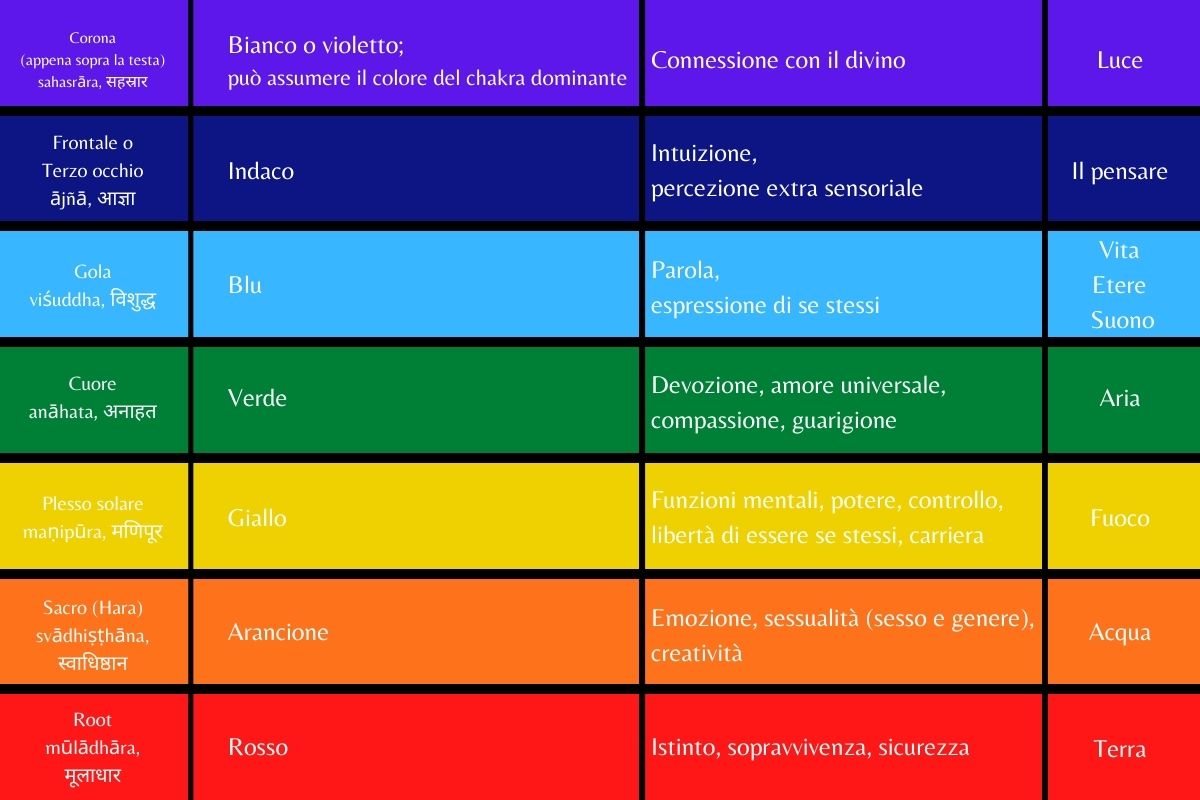
Those who practise chromotherapy as a technique within Ayurvedic medicine often associate colours with the chakras, the “energy centres” which, according to ancient philosophical theories, correspond to various endocrine glands: according to this theory, the energies of the chakras are linked to the parasympathetic and autonomic nervous systems and to the regulation of hormones. There are seven chakras, divided into three upper and four lower chakras. Each of the seven corresponds to one of the seven colours of the rainbow (plus white) and influences a particular organ or one of the main glands in our body.
The following table sets out some of the properties of each chakra and the colour associated with it: