
Grumento Nova (Saponaria di Grumento, or simply Saponaria – so much so that the inhabitants were known as ‘saponaresi’ – until 1932) It is an Italian municipality in the province of Potenza, situated next to the Roman town of the same name (Grumentum), which still boasts a well-defined archaeological site and the National Archaeological Museum of the Upper Val d’Agri.
The town lies at an altitude of 780 metres above sea level in the Val d’Agri, in the central-western part of the Potenza province, just over 70 km from the provincial capital.
History
Grumento Nova is the oldest and most important town in Roman Lucania.
Its former name was Grumentum: It originated in the Val d’Agri, enduring over a millennium of history before suffering barbaric destruction at the hands of the Saracens in 878 AD.
The fleeing inhabitants managed to save themselves by scattering into the surrounding areas; some of them took refuge on a hill overlooking the town: the Saponara. This hill gave its name to the new settlement (954 AD), which retained it until 3 November 1932, when the ancient place name was reinstated, with a slight variation (Grumento Nova).
The ancient Roman city met its most disastrous end in 1031 AD.
It was Roberto d’Altavilla who settled people on Saponara Hill – becoming the city’s first lord – and built a castle around which the town would develop Village, another urban centre which, merging with Casaletto, will bring the town of Saponaria to life.
The Altavilla family (Hauteville) is of Norman origin (northern France); the earliest records of Robert are found in Montecaveoso (Montescaglioso) in 1055, where he was Count. His son Guglielmo inherited Polla, Brienza and Saponaria itself. This later passed to Frederick II of Swabia, who, however, found himself embroiled in a revolt instigated by Pope Innocent IV due to disagreements between the two.
The conspiracy involved several feudal lords, including the Fasanellas, the Sanseverinos, the De Marras and the Franciscos, and went down in history as the “Capaccio Conspiracy”. Pandolfo di Fasanella was its leader, and Tommaso, Lord of Saponaria, also followed his orders.
In 1254, the town passed into the hands of the Sanseverino family (who had taken part in the revolt), accused of supporting the Angevins; as a result, Manfredi, son of the deposed Frederick II, sacked the town. The Angevins, in gratitude, returned Saponaria – through Charles I of Anjou – to Count Ruggero Sanseverino, whose lineage would rule until 1806.
In 1254, Saponaria passed into the hands of the Sanseverino family and was sacked at the behest of Manfredi, son of Frederick II, because the new feudal lords were siding with the Angevins. In 1267, King Charles I of Anjou restored the town to Count Ruggero Sanseverino, whose family ruled it until 1806.
The French did not even spare Grumentum: Giuseppe Bonaparte appointed Tommaso di Saponara as minister of the Kingdom of Naples. During the Risorgimento, many citizens took part in the liberal uprisings of 1820–21 (led by Gherardo Ceramelli), in 1848 (led by Antonio De Cilla) and in the Mazzinian movement of 1853 (led by Giulio Cesare Giliberti).
Another event in 1857 left its mark on the impoverished town: a devastating earthquake that claimed over two thousand lives.
And, following the unification of Italy, it was not spared the phenomenon of banditry: among the most famous bandits are Donato “Caronza” Toscano and Diego “Lineo” Di Rago. The Royal Decree of 21 April 1863 changed the town’s name to Grumento and then, on 3 November 1932, it became, once and for all, Grumento Nova.
Little Pompeii
It is not difficult to see why Grumento has been given this name. Of particular note are the archaeological park (the ancient ruins of Grumentum) and the associated National Archaeological Museum of the Upper Val d’Agri.
Two prominent families ruled the town: the Sanseverinos and the Altavillas, who brought the town periods of splendour and decline.
It’s not just Roman ruins: consider the archaeological park with its amphitheatre, which hosts performances by the Teatri Uniti di Basilicata, as well as the ancient stately homes (such as Sanseverino Castle or the former court hall – in the centre of the village – which was later converted into stables).
As well as the nearby Archaeological Park, with its picturesque amphitheatre which provides the backdrop for the summer theatre performances by the Teatri Uniti di Basilicata, the town also boasts a number of ancient stately homes. One of these is Sanseverino Castle, built in 1100 and restored by Carlo Maria Sanseverino in 1700, though it was almost destroyed by the 1857 earthquake that devastated the entire Val d’Agri. Of particular note, in the centre of the village, is the ancient court hall of the Sanseverino family (later converted into stables), which at the end of the 17th century
Monuments and places of interest
Sanseverino Castle
The castle owes its construction to the Counts of Montescaglioso, the first feudal lords of Saponaria, in the second half of the 11th century. Count Roberto built his residence on the hill, around which an entire village sprang up.
The city walls, featuring seven gates, were built at a later date. Thanks to the Sanseverino family, the castle was subsequently extended further: the 1749 land register states
The distinguished Luiggi Sanseverino… owns a palace comprising over two hundred residential properties, with an adjoining garden
It originally stretched from what is now Largo Umberto I to Piazza Municipio. Around 1700, Prince Carlo Maria Sanseverino completely renovated it, restoring it to its former splendour and extending it to its full length.
It is believed that he was responsible for the construction from scratch of the spacious court hall (the only part of the feudal palace that remains intact to this day), which, in the late 17th century, hosted the reception for the second wedding of Princess Aurora Sanseverino, a poet and patron of the arts.
Like any self-respecting castle, this one also has a garden, which is accessed via a flight of steps that can be made out from some traces still visible in Via Roma.
The redesign of the spaces envisaged by Carlo comprises twelve flats as well as a
a charming theatre for musicals and comedies
as a testament to the prince’s passion for this art form, of which he is both a connoisseur and a creator. Indeed, on the occasion of his daughter Aurora’s wedding – as mentioned earlier – he commissioned a performance of his own musical comedy entitled “Eliododro”.
Alongside this was a vast stable – large enough to house up to one hundred and twenty-two horses – which was accessed via an open area (the fence) now known as Largo Umberto I. On either side stood two towers, which have since disappeared.
The courtyard, however, remains, complete with a cistern, on the terrace above the stables themselves.
Religious architecture
- Mother Church of Saint Antoninus, Bishop and Martyr
- Church of St Laverio the First Martyr
- Church of Our Lady of Monserrato
- Church of Our Lady of Grumentino
- Church of St John
- Church of Our Lady of the Rosary
- Church of St Joseph: destroyed by the earthquake of 1857, it was rebuilt in 1860 (as stated on the inscription above the entrance door) by Andrea Giliberti; today it is known as the Giliberti Chapel.
- Church of St Catherine of Siena
- Mother Church of Grumento
The Mother Church of Grumento Nova stands on the northern side of the hill on which the village is situated. It was founded in 1118 on the site of a pre-existing pagan temple and was consecrated to Antoninus of Apamea (Syria), following the rise of William of Altavilla as feudal lord. A second theory, however, suggests that this place of worship originated with French Cistercian monks in the retinue of Ildebrando di Soana, who later became Pope Gregory VII.
In 1561, the church underwent its first renovation thanks to Archpriest Bernardino Giliberti. A few decades later, in 1604, the Cotino family had a chapel dedicated to the Holy Cross built on the right-hand side of the building. The wall paintings in the niche on the right, inside the church, date from this period.
In 1609, the three-storey bell tower was built. The bell was commissioned by Bernardino Cioffi, the first mitred archpriest. In 1635, Archpriest Francesco Danio oversaw the extension of the church, commissioning the construction of three chapels.
At that time, the church had the following architectural features:
- the Romanesque-style façade clad in opus reticulatum;
- the nave, flanked by a double row of three smaller chapels;
- the ceiling, consisting of framed planks;
- the choir, with a square plan, was the same width as the nave. It contained sixteen large walnut seats and fourteen smaller ones, intended for the priests of the Chapter. At the centre stood the high altar, consisting of five wooden niches containing, on the left, the statues of St Paul and St Stephen; at the top centre, St Michael the Archangel; and at the bottom, a reliquary housing the remains of St Giovenzio. The chapels were under the patronage of the local noble families, who had the right to be buried there. The terrible earthquake of 16 December 1857 razed the church to the ground; it was rebuilt in the following years. Today, the façade is in the Neoclassical style, with a bell gable, and the church features the following architectural characteristics: a Latin cross plan, a transept 22 metres long, a nave 13 metres wide, a semicircular apse and a bell tower with a square base. The name of its architect is unknown.
Archives and libraries
Carlo Danio Municipal Library, Grumento Nova
The Grumento Library was founded around the 17th century at the behest of Carlo Danio, nephew of the famous jurist Amato Danio, who contributed to its establishment. Amato Danio, inspired by the cultural fervour that had developed in ancient Saponaria, his interest in the nearby colony of Grumentum and his love for his native land, undertook various studies in Naples with a view to sharing his knowledge by teaching the young people from the Valdagrino valley who had moved there.
Carlo Danio – archpriest of the Insigne Collegiate Church – “took up” his relative’s legacy, first and foremost by moving the library to Saponaria, making it accessible to scholars, and building a museum next to it to house ancient artefacts from Grumentum.
Although this library has suffered considerable losses, it remains one of the best-stocked in the region to this day, at least as far as ancient works are concerned: it even holds books dating back to the 15th century, the first to be printed using movable type.
Since 2018, the library has been housed in the historic Giliberti Palace (which once belonged to the Gilbert family), which now spans two floors: the ground floor houses the modern collection, comprising around 2,000 volumes, and a range of multimedia resources; the upper floor, on the other hand, is dedicated to displaying the collection of antique books, comprising 2,205 volumes.
The lake
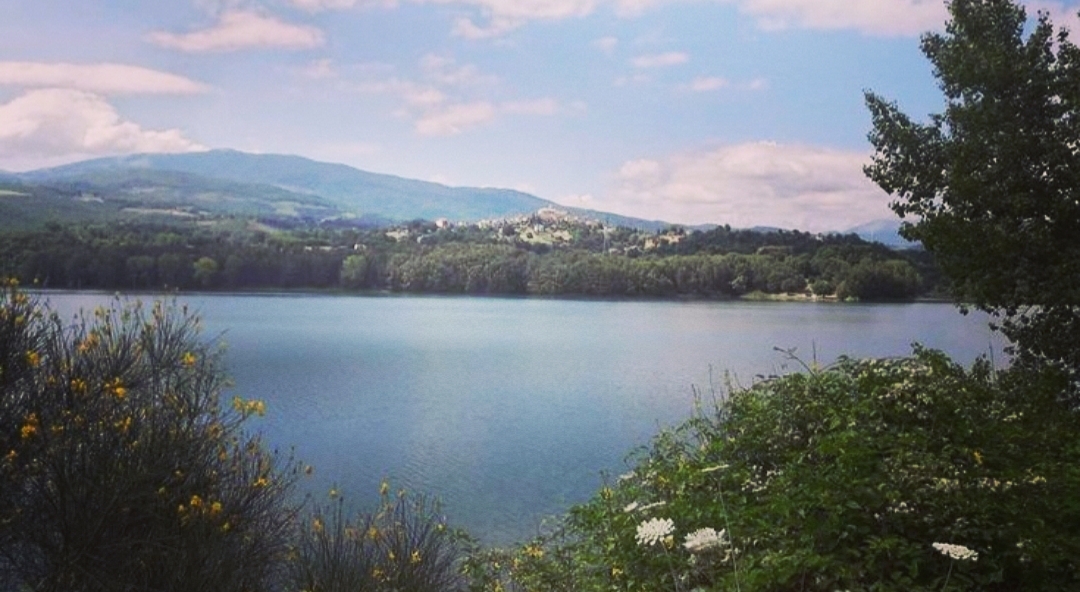
The area around Grumento, together with those of Sarconi, Spinoso and Montemurro, is home to a marvellous lake: Lake Pietra del Pertusillo. This lake is bordered by the Bosco Farnie, a woodland full of chestnut and beech groves where you can “lose yourself” before reaching the lake.
Not to be forgotten is the Bosco Maglie, which is home to the “Bosco dei Cigni” local education centre.




